Slovograd Rules
Goal
Score more points than your opponent. The game runs until a set number of points is reached (200 by default).
Tiles
Each player holds 7 tiles. The bag holds 131 tiles with letters, 3 of them asterisks. An asterisk stands for any letter.
Move
Place a word horizontally or vertically so that it connects to the tiles already on the board. The first word is placed through the center square and has at least two letters. All words formed must be in the game's dictionary. The same word can be played only once in a game. After your move you draw tiles back up to 7. Instead of placing a word you can pass or exchange tiles. You can exchange as many tiles as are left in the bag, but no more.
Scoring
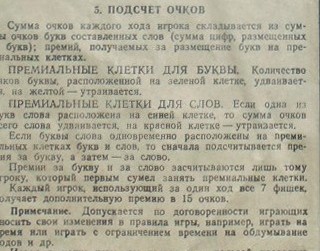
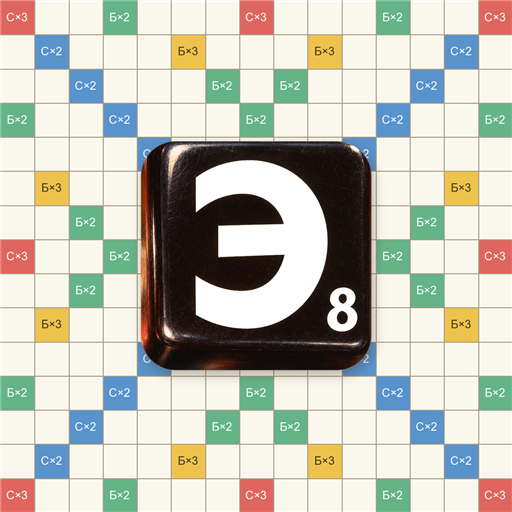
A word scores the sum of its letters' points. The squares “L×2” and “L×3” multiply the points of a letter, “W×2” and “W×3” the points of the whole word. The bonus goes to the player who is first to cover a square. If a word covers two word squares, the multipliers are multiplied together. The center square has no bonus. Placing all 7 tiles in one move: +15 points.
End of the game
When one of the players reaches the required number of points, the others finish the round. The game also ends when, with the bag empty, someone places all their tiles: the others finish the round. When the bag is empty and all players pass two rounds in a row, the game ends. The player with more points wins. There is no penalty for tiles left over.
Frequently asked questions
Can the computer see my tiles?
No. It knows only the tiles on the board and its own.
Does the computer get better tiles?
No. Tiles are drawn from the bag at random, the same for both. The difficulty level changes only how the computer chooses words, not its tiles.
How are tiles drawn from the bag?
Before the game the tiles are shuffled once at random. The first deal must contain at least one vowel and two consonants (an asterisk counts as any letter), otherwise the deal is repeated. The letters «Ь» and «Ъ» (the soft and hard signs) count as neither a vowel nor a consonant. There is no separate tile for the letter «Ё»; in the dictionary «ё» is treated as «е». When you exchange tiles, you first draw new ones and then put the old ones back into the bag, which is shuffled again.
Which words you can play
The game accepts only nouns: words that answer the question «кто? что?» (“who? what?”). A word is written in its base form: nominative case, singular («стол», “table”, not «стола»; Russian nouns change their endings by case, and the game uses only the base form). If a word exists only in the plural, it is also accepted: «щи» (shchi, cabbage soup), «ножницы» (scissors), «санки» (sled).
Verbs, adjectives and other parts of speech are not accepted. Proper names (cities, countries, first names, brands, names of organizations), words with a hyphen or a space, abbreviations and acronyms are not accepted either.
We removed coarse profanity and offensive words, diminutive and affectionate forms («ноченька», “little night”) and feminine forms of titles («врачиха», “female doctor”): the base word is played instead.
Found a strange word, or missing one you need? In the game you can report a computer's word and suggest a word. We check every request by hand.
As it was in the original
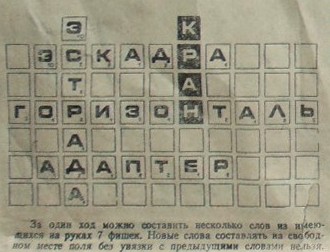
Fragments of the instructions for the game Erudit («Erudite»). The game Slovograd is built on these rules.